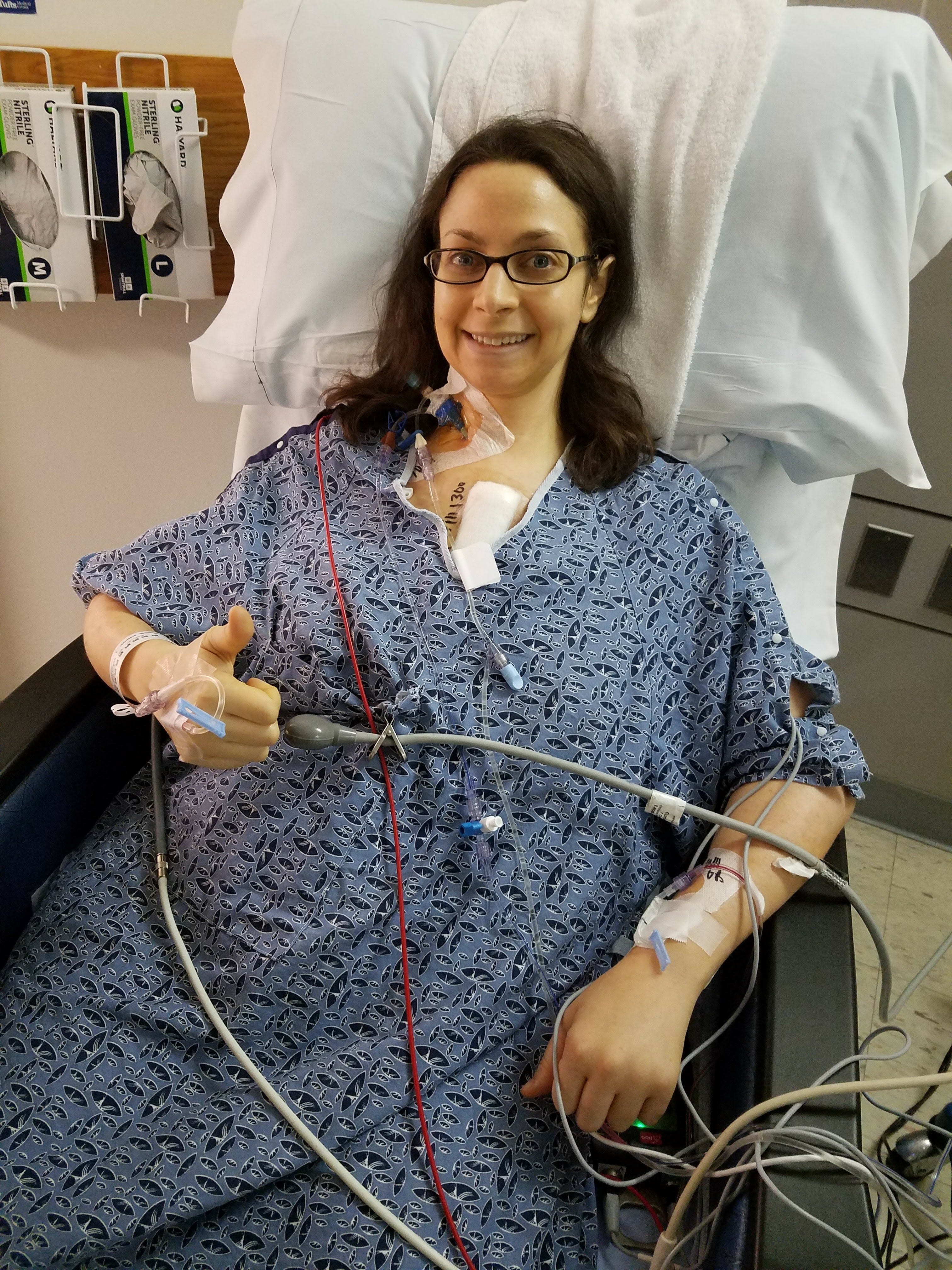

“Anniversaries live in your body, not just your mind.”
-Tanmeet Sethi, MD
Surgiversary #10
Ten years. TEN YEARS! A whole decade has passed since I had open-heart surgery to remove the obstruction to blood flow through my heart, caused by the genetic heart condition Hypertrophic Cardiomyopathy (HCM).
Last year at this time, I wrote about how I struggle to celebrate Surgiversaries, or surgical anniversaries, and wondered how I would celebrate the huge milestone of ten years in 2026.
Well, the big Surgiversary week is here, and I am celebrating… by living!
As you read this, I am traveling to visit family and friends, and to attend the Hypertrophic Cardiomyopathy Association’s Annual Patient Meeting.
Travel.
Filling my emotional cup.
Continuing to be a student of my disease.
Convening with other HCM patients who have been through similar experiences, including open-heart surgery.
I think that’s a pretty great way to mark the occasion of living ten years beyond a day that was both transformative and traumatic.
I’ve never written publicly, in detail, about the septal myectomy, the open-heart procedure itself, despite writing about many of the events and emotions that surrounded it.
Until now!
What is a Septal Myectomy?
In 2011, the first cardiologist I ever saw told me, on day one, that I would probably need open-heart surgery at some point to relieve my symptoms.
I chose not to believe him.
He hadn’t really explained why he was recommending this procedure or how it was done. Not well enough for me to get it and buy into it anyway. Open-heart surgery sounded too scary to consider.
So, let’s do some definitions that I wish someone had shared with me during that first cardiology appointment:
Septum means “a dividing wall or membrane especially between bodily spaces or masses of soft tissue.”1 In the case of the heart, a “band of muscle called the septum separates your two ventricles. In hypertrophic cardiomyopathy, the septum thickens and may bulge into your left heart ventricle. This bulging blocks blood flow, meaning your heart has to work harder to pump blood through your body.”2 The ventricles are the lower chambers of your heart.
Myectomy, and its sister, the myotomy, “are related surgical procedures, both involving careful intervention on muscle tissue to restore proper function or relieve blood flow obstruction. Myotomy involves an incision, and myectomy involves the removal of damaged tissue.”3
Therefore, when you combine them, a Septal Myectomy is “surgery to thin out the wall between the left and right side of the heart… Thinning the septum also reduces mitral valve regurgitation, a condition in which blood flows backward into the atrium, or upper chamber of the heart. Septal myectomy is the most commonly performed surgical procedure for people with HCM.”4
If all this terminology is new to you, no worries! Most non-cardiology doctors I encounter don’t know what it is either. I’ve had at least a dozen confuse it with a myomectomy, which is “a surgery to take out fibroids from the uterus.”5 A completely different procedure. It also differs from common bypass surgeries.
Understanding Why I Needed a Septal Myectomy
So, in 2012, when I sought out a Cardiologist who specialized in Hypertrophic Cardiomyopathy, I went into my first appointment with him feeling undereducated about the disease and the reality of my options. Dr. Martin Maron, who was at Tufts Medical Center in Boston, at the time, quickly educated me by showing me my own Cardiac MRI images.
Here is a never-before-seen passage from my memoir-in-progress about the day I finally understood what a septal myectomy was and why I needed to have one:
My Cardiac MRI showed a “left ventricular anteroseptal wall thickness” of 19mm. Right in the sweet spot for someone with the obstructive version of Hypertrophic Cardiomyopathy. Though, I was delusional enough to think, “well, 19mm isn’t so bad compared to how big some HCM patients’ septa are, if they can go all the way up to 60mm.” Right?
Wrong! In fact, so wrong that Dr. Maron guided the next part of our conversation towards the very topic I had been dreading. Open-heart surgery.
“Deb, the other less-invasive surgical options are not really great options for you,” he said.
I listened, horrified.
A septal ablation, he explained, which is when they burn off some of the excess heart muscle, might leave me with new arrhythmias and wouldn’t be complete enough or have long-lasting results.
A cardioversion, where they shock your heart, was reserved for people who were already having severe arrhythmias, but that wasn’t how my symptoms were displaying themselves.
“Your problem is the thickness of the septum and its interference with the mitral valve, along with some problems with the papillary muscles,” he said. “The single best solution for that is a septal myectomy.”
I would be shocked if my jaw wasn’t actively hanging on the floor as he explained what a septal myectomy (pronounced: sep-tull my-eck-toe-mee) entails, as opposed to the vague concept of one that I had cooked up in my overactive brain.
It is full-on open-heart surgery.
They put you on bypass, saw your sternum in half, slice into your heart, and cut out the excess heart muscle, thereby removing the obstruction. Oh, and they would re-position my mitral valve while they were in there, all before putting my chest back together with some combination of wires and glue.
I don’t phrase it that way to be flippant. Quite the opposite. Because once I saw my Cardiac MRI, heard Dr. Maron’s assessment, and understood what a septal myectomy was, it was abundantly clear that it was the right treatment option.
Knowing it was the right treatment option didn’t mean it was easy to accept, but it did give me clarity that a septal myectomy would become part of my treatment path, and I embarked on a years-long journey to accepting that.
What happens during the surgery?
According to the Cleveland Clinic, one of the highest-volume surgical centers performing septal myectomies, the surgeon:
-
“Makes a large incision down the middle of your chest and separates your breastbone (sternum) to reach your heart.
-
Connects you to a heart-lung machine that takes over the work of your heart and lungs during surgery.
-
Removes the thickened portion of your septum.
-
Disconnects the heart-lung machine.
-
Puts your breastbone back together and closes the incision with absorbable sutures.
A septal myectomy usually takes between three and four hours.”6
My medical records tell me that I was on bypass for 139 minutes, and my surgery took a total of approximately four hours.
Beth Israel Lahey Hospital & Medical Center in Burlington, Massachusetts, where Dr. Maron and his team now run their Hypertrophic Cardiomyopathy Center of Excellence, has a helpful video depicting how the surgery is done (note: this video uses digital graphics, rather than real surgery footage)7:
What is the recovery process like?
Most myectomy patients are in the Intensive Care Unit (ICU) for a day or two post-op, then move to a step-down unit for 3-5 days before being discharged to their home. It’s best to have friends or family around to help afterwards because there are restrictions on lifting and reaching.
I was in the Cardiac ICU for 6 days because I developed complete heart block from the surgery. The electrical signal from the upper chamber of my heart was no longer reaching the lower chamber.8 I ended up needing a second surgery to place an Implantable Cardioverter Defibrillator (ICD), which is both a pacemaker and a defibrillator. But on day 7, I finally made it to the hospital’s step-down unit, and I was released on day 9.
I’ve talked to some septal myectomy patients who were back to most of their regularly scheduled activities after 8 weeks. Most patients fully recover in an average of 3 months. It took me a year and a half. So, it’s a pretty broad spectrum.
Some people need little or no physical or occupational therapy post-op. I had 10 months of cardiac rehabilitation, which was essential to my recovery process.
Once I had fully recovered, my symptoms did improve. I remember Dr. Maron telling me that something like 80% of septal myectomy patients feel 80% better afterwards. That percentage is even higher now, as they’ve fine-tuned the procedure in the last decade.
“Septal myectomies have high success rates. In one study, 94% of people experienced symptom improvements after surgery. Long-term, people who had a septal myectomy had the same survival rates as the general population.”9
My advice for other septal myectomy surgical candidates
My Dr., Marty Maron, is the son of Dr. Barry Maron, one of the earliest cardiologists to focus his efforts on treating patients with Hypertrophic Cardiomyopathy. On Hypertrophic Cardiomyopathy Awareness Day in February 2022, Barry Maron said something that resonated with me so strongly that I had to write it down:
“Septal myectomy is about the ability to reverse heart failure.”
Short, simple, but jam-packed with information. In that one sentence, the elder Dr. Maron summed up just what an important medical advance the septal myectomy is.
I had spent so much time resisting the surgery and being terrified to go through with it that I never stopped to consider how lucky I was that surgery was even an option for me. And that the odds were really good it would help me. If I didn’t have an obstruction, I would have been almost out of options, at that time, when the medications didn’t relieve my symptoms. A septal myectomy was, and is, HUGE progress in HCM care.
I wish I heard Dr. Maron say this many years earlier. Now, I share the sentiment that we are lucky to have this surgical option with other HCM patients who are considering a myectomy as part of their treatment plan. I also offer three other pieces of advice:
-
Only consider having the surgery done at a high-volume center. Meaning, a Center of Excellence in Hypertrophic Cardiomyopathy, where the surgeon specializes in septal myectomies and performs them regularly. Outcomes are better.
-
Attend the Hypertrophic Cardiomyopathy Association’s Pre-Myectomy Education Session for Individuals Scheduled for Surgery. It’s the best way to prepare.
-
Have your support system around you. You’ll need them, even if things go smoothly and it’s for a short time.
What surgical advancements are ahead?
While the septal myectomy was indeed an excellent advancement in HCM surgical treatment, it has also been the only one for more than 60 years. But I’m pleased to report that several others are on the horizon.
In short, there are multiple options coming for patients with the same diagnosis I received in 2011, and none of them include having your sternum sawed in half. That’s amazing.
I’m looking forward to learning more about these new procedures during a session at the Hypertrophic Cardiomyopathy Association’s Annual Patient Meeting this weekend, and I will report back in my reflections on that event two weeks from now.
What would I tell the October 2016 pre-op version of myself?
You did it! You overcame all of the fear and uncertainty that came with open-heart surgery, and it gave you the opportunity to keep contributing to the world. You will still be here ten years later to tell your story, and it will help other people when you do.
It won’t be an easy road, by any stretch of the imagination, but it will still be worth it. You can do hard things, so hang in there.
Here’s to the next decade!
Each issue of “What’s Her Problem?” includes questions for further discussion. Leave a comment below!
This week’s questions:
Had you ever heard of a septal myectomy before? Do you feel like you could explain it to someone else now, at least in broad terms?
Up Next:
On Friday, 10/16, I’ll share my Q&A with Family Medicine physician Dr. Jennifer A. Kabak. We talk about the shrinking Primary Care workforce and the day-to-day realities of working in her field.
In Case You Missed It:
I was recently a guest on the Hypertrophic Cardiomyopathy Association’s Tales from the Heart podcast. If you want to learn more about other advances in HCM treatment, Founder and CEO Lisa Salberg spoke about all of the upcoming clinical trials in HCM medication, including new classes of drugs. Check out our chat, which included fellow HCMA Ambassador Joe Ulery Graham, here:
Leave a Reply